DSM vs DanceStudio-Pro: Feature Comparison (2025)
Choosing dance studio management software often comes down to how well it supports your billing complexity, reporting needs, and long-term growth.
Both Dance Studio Manager (DSM) and DanceStudio-Pro are established platforms that cover core studio operations. However, they differ in how deeply they handle advanced administration, customization, and data control.
This comparison focuses on documented features and workflows, highlighting where DSM offers tools that are not clearly available or emphasized in DanceStudio-Pro.
Feature Checklist: Capabilities Compared
This checklist focuses on advanced and operational features beyond basic scheduling and billing.
 |
 | |
|---|---|---|
|
Online registration & enrollment | ||
|
Class scheduling & attendance | ||
|
Auto-pay & recurring billing | ||
|
Parent & staff portals | ||
|
Mobile app access | ||
|
Recital & event management | ||
|
Costume tracking | ||
|
Custom tuition structures (session plans, punch cards) | ||
|
Family-level billing rules & discounts | ||
|
Exportable financial reports (PDF / Excel) | ||
|
Client-level financial statements | ||
|
Advanced attendance & enrollment reports | ||
|
Custom report filtering & data views | ||
|
Multi-location consolidated reporting | ||
|
Point-of-Sale (POS) inventory tracking | ||
|
Merchandise & retail sales reporting | ||
|
Open API / advanced integrations | ||
|
Custom admin permission controls | ||
|
International / multi-currency studio support |
Key Differences Explained
1. Tuition Flexibility and Pricing Control
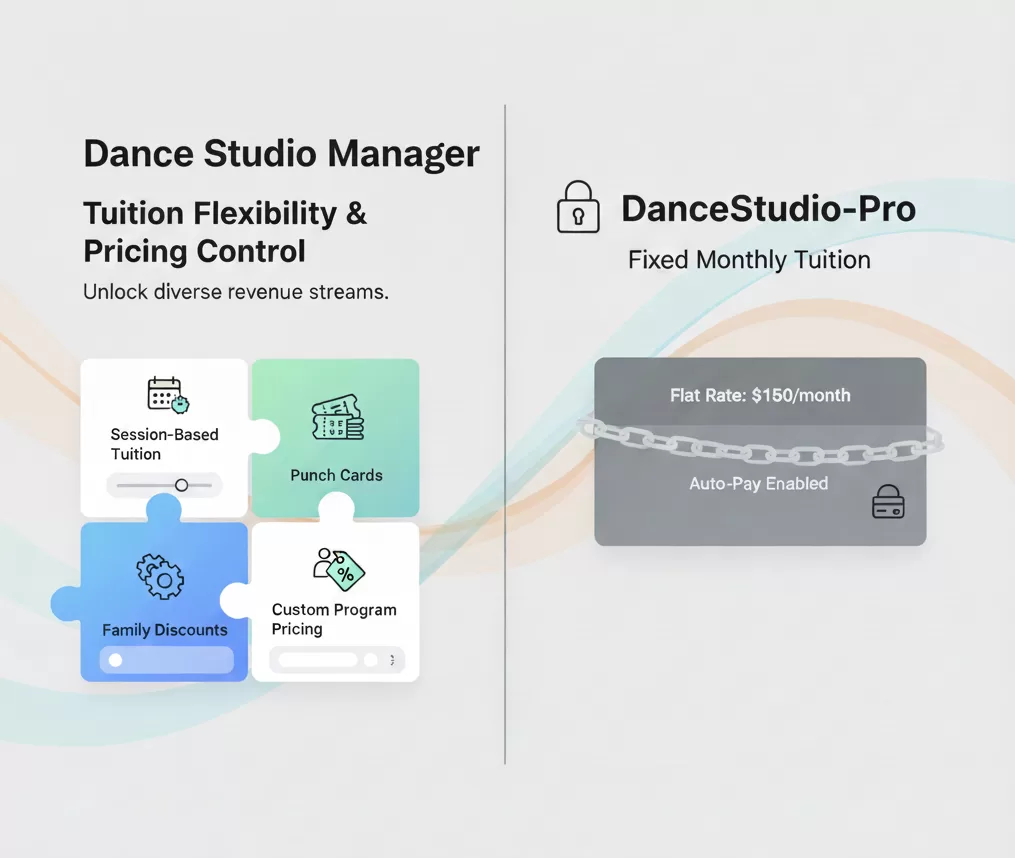
DSM supports non-standard billing models such as:
Session-based tuition
Punch cards
Family-level discounts
Family-level discounts
DanceStudio-Pro primarily focuses on flat monthly tuition with Auto-Pay, which works well for many studios but may feel limiting for studios with mixed programs or flexible pricing.
2. Reporting Depth and Export Control
DSM offers exportable reports (PDF and Excel) for:
Financial summaries
Attendance tracking
Enrollment trends
Client statements
This is useful for studios that need offline analysis, accountant sharing, or custom data review.
Studio Pro emphasizes dashboards and built-in views, but does not clearly document the same level of export flexibility.

3. Client-Level Financial Transparency
DSM provides detailed client financial statements, making it easier to:
Review payment history
Track balances
Share statements with families
While Studio Pro includes billing history, DSM’s documentation emphasizes statement-level visibility as a core admin feature.
4. Multi-Location Reporting
DSM clearly supports centralized reporting across multiple studio locations, allowing owners to:
Compare performance by branch
View consolidated revenue
Track enrollment across locations
Studio Pro supports multiple locations but does not clearly highlight consolidated reporting depth in public materials.
5. Retail & Inventory Management
DSM includes Point-of-Sale (POS) tools for:
Merchandise
Workshop materials
Retail tracking tied to reporting
Studio Pro supports payments and add-ons but does not clearly document a full POS-style inventory and reporting system.

6. Integrations and Data Control
DSM supports advanced integrations and API access, allowing studios to connect:
Accounting tools
Custom reporting systems
External workflows
Studio Pro offers Zapier integration, but DSM’s API-level access provides deeper customization for technical or scaling studios.
Which Platform Fits Your Studio Better?
DSM vs DanceStudio-Pro
Both DSM and DanceStudio-Pro handle essential studio management tasks well.
The difference lies in depth vs simplicity.
DanceStudio-Pro prioritizes ease of use and marketing workflows, while DSM provides greater control over billing logic, reporting, inventory, and multi-location operations — features that become increasingly valuable as studios grow and diversify.
-
-
-
-
-
-
-
-
-
-
-
-
-
-
-
Dance Studio Software Comparison: DSM vs StudioBookings
LEGEND: = fully supported = limited = not a core feature Frequently Asked Questions (FAQ)