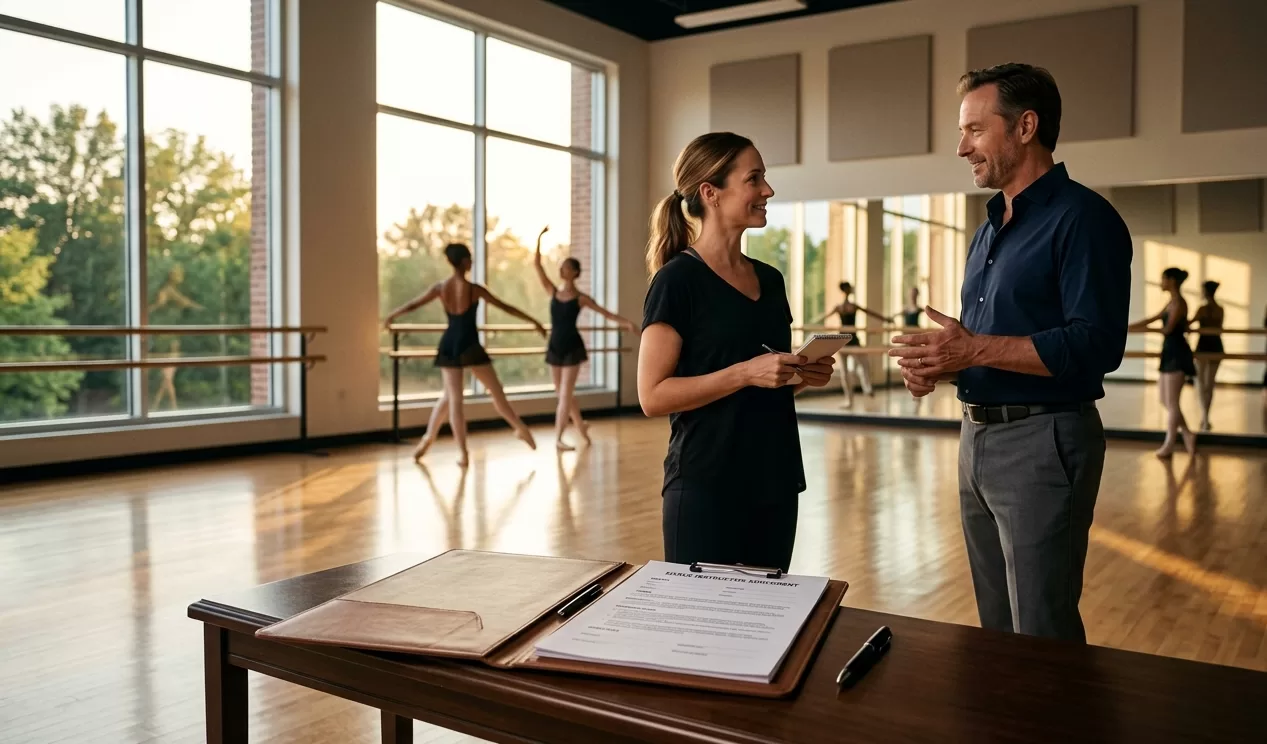
A useful dance teacher contract turns the studio's actual working arrangement into clear, reviewable terms. It should identify the role, schedule, compensation, paid duties, cancellation rules, policies, ownership questions, and ways the relationship can end. It should not be used to disguise an employee as an independent contractor or copied from another studio without local review.
This guide is a planning resource, not a legal contract or legal advice. Employment, tax, wage, privacy, safeguarding, noncompete, and termination rules vary by country, state, province, and city. Use the checklist to organize your decisions, then have a qualified local professional review the agreement you intend to sign.
Quick answer
A practical dance teacher agreement usually covers twelve areas: parties, term, role, classification, schedule, compensation, other paid duties, cancellations and substitutes, conduct and safety policies, confidential information, choreography or media rights, and termination.
The contract's label does not decide whether a teacher is an employee or independent contractor. In the United States, the IRS looks at behavioral control, financial control, and the parties' actual relationship. The Department of Labor uses a separate FLSA analysis, and state tests can be stricter or simply different.
What a contract can—and cannot—do
A written agreement can prevent routine misunderstandings. It can say which classes are assigned, when schedules may change, what preparation or rehearsal work is expected, how pay is calculated, who finds a substitute, what happens when the studio closes, and which policies apply.
It cannot override wage laws, tax rules, worker-protection statutes, or the facts of the relationship. The IRS expressly notes that a written contract calling someone an independent contractor is not enough by itself. How the studio and teacher actually work together matters.
Decide worker classification before drafting the template
Do not begin by choosing the cheaper label. Begin by documenting the real arrangement. Who controls the schedule, teaching method, pricing, student relationship, substitutions, training, equipment, and opportunity for profit or loss? Is the teacher offering an independent business to the market, or performing a central and continuing part of the studio's normal business?
For U.S. federal tax purposes, the IRS groups relevant facts into behavioral control, financial control, and type of relationship. For federal wage-and-hour purposes, the Department of Labor examines the economic realities of the relationship. Federal classification policy is also subject to rulemaking and litigation, while states may apply their own tests.
If the answer is uncertain, get local advice before signing or paying the teacher. The IRS can make a federal employment-tax determination through Form SS-8, but that process is not a substitute for timely legal and payroll guidance.
Dance teacher contract checklist
| Section | Decisions to document | Records to keep aligned |
|---|---|---|
| Parties and term | Legal names, effective date, fixed term or ongoing relationship, renewal process | Current signed version and contact information |
| Role and classes | Styles, levels, age groups, locations, reporting contact, schedule-change process | Class schedule and assigned-teacher list |
| Classification | Employee or contractor analysis based on actual facts, not only the agreement title | Legal, tax, payroll, and insurance review |
| Compensation | Hourly, per-class, commission, or hybrid formula; pay dates; approved expenses | Time, class, attendance, and pay records |
| Other duties | Preparation, meetings, rehearsals, performances, travel, training, communication, and admin | Required-duty list and compensable-time policy |
| Cancellations | Studio closure, low enrollment, teacher absence, substitute approval, makeup classes | Cancellation notices and substitute records |
| Policies | Safety, safeguarding, attendance, conduct, social media, confidentiality, and data handling | Policy handbook and acknowledgement date |
| Creative and media rights | Choreography, lesson materials, music edits, photos, recordings, and promotional use | Specific permissions and releases |
| Ending the relationship | Notice, immediate-termination grounds, final duties, return of property, final pay | Applicable law and documented handoff |
Test whether the contract matches the working setup
Before the agreement is signed, compare it with one real class. In Dance Studio Manager, the studio can assign the instructor and schedule while an authorized teacher uses a phone or computer to open today's class, view its roster, and record attendance. Confirm that the teacher can see the information needed for class without receiving unrelated administrative or financial access. DSM is not payroll or legal-compliance software, so the agreement and pay process still need qualified local review.
Try the teacher handoff before rollout
Create one teacher, assign a sample class, check the permission-based staff view, and record sample attendance.
A sample outline to take to your attorney
This is a drafting outline, not a ready-to-sign contract. Replace every bracketed decision with the actual arrangement and local advice.
- Parties and effective date. Identify the studio's legal entity and the teacher's legal name.
- Term. State the start date, whether the agreement is fixed-term or ongoing, and how renewal works.
- Services and reporting. Describe teaching assignments, locations, age groups, non-teaching duties, and the studio contact.
- Worker status. Record the classification selected after reviewing the real relationship and applicable tests.
- Schedule. Attach or reference the current schedule and explain how changes are approved and communicated.
- Compensation. State the rate or formula, pay period, payment method, approved expenses, and treatment of required extra work.
- Attendance and substitutes. Define notice, substitute qualifications, approval, and responsibility for makeup classes.
- Studio policies. Incorporate only policies the teacher can actually access, and identify which version controls.
- Confidential information and records. Define protected studio, family, and student information and how it must be returned or deleted.
- Creative work and media. Address choreography, lesson materials, recordings, photos, credits, licenses, and permitted reuse.
- Termination and handoff. State notice, lawful immediate-termination grounds, final class and record duties, and property return.
- Local legal terms and signatures. Add governing-law, dispute, amendment, notice, and signature language recommended by local counsel.
Write compensation so another person can calculate it
A pay clause should be reproducible. “Paid per class” is incomplete unless the agreement also defines the class length, rate, canceled-class treatment, substitute pay, rehearsals, performances, meetings, preparation, communication, and any enrollment-based component.
Use the companion guide to compare hourly, per-class, commission, and hybrid dance teacher pay, then use the dance teacher pay-rate guide to evaluate the amount against local evidence and the complete workload. For employees, coordinate the contract with timekeeping and payroll rules. The Department of Labor explains that covered nonexempt employees must be paid for compensable hours worked; a flat class rate does not make required preparation or meetings disappear.
Separate the class assignment from the rest of the job
A teacher may also plan lessons, answer family questions, attend meetings, rehearse students, supervise backstage areas, travel between studio locations, complete training, create music edits, or submit attendance and notes. List the duties that are required, who approves them, when they happen, and how they are recorded and paid.
This improves the agreement even when the teacher is a legitimate contractor. It clarifies the scope of the engagement and exposes work that otherwise becomes an unpaid assumption.
Define cancellations, substitutes, and schedule changes
Studios and teachers should know what happens when weather closes the building, enrollment falls below a threshold, a teacher is ill, the recital calendar changes, or a substitute is needed. State who may cancel, how much notice is required, whether a class is rescheduled, who selects and pays the substitute, and whether the original teacher receives any cancellation payment.
A policy that sounds clear in conversation may fail when a closure affects six teachers and forty families. Test the language against one real scenario before signing.
Use policies without turning the contract into a moving target
The agreement can require compliance with a separate handbook covering safeguarding, safety, attendance, professionalism, communication, confidentiality, and technology. Identify the handbook version, provide access before signing, and use an acknowledgement when material policies change.
Be specific about student and family data. Define which systems the teacher may access, whether information may be downloaded or photographed, how incidents are reported, and what happens to records and credentials when the relationship ends.
Address choreography, music edits, and recordings deliberately
Choreography can raise copyright and ownership questions. The U.S. Copyright Office explains that some choreographic works may be protected when fixed in a tangible medium, while individual steps, commonplace movements, and social dances may not qualify. “Work made for hire” also has specific legal requirements.
Do not rely on a sentence that simply says the studio owns everything. Ask counsel to define what is being created, who owns or licenses it, whether the teacher may reuse it, how credit works, and whether the studio may record or promote it. Music licensing and permissions for students' images are separate issues.
Plan termination and the final handoff
State the ordinary notice process and the circumstances in which immediate action may be lawful and appropriate. Address final teaching assignments, family communication, attendance or progress records, studio property, keys, passwords, files, costumes, music, and final compensation.
A termination clause is not permission to ignore local notice, final-pay, leave, discrimination, retaliation, or contract law. Have the complete clause reviewed for the places where the teacher will actually work.
A five-minute agreement review
- Can the teacher identify every required duty and where it will happen?
- Can a payroll or accounting person calculate every component of pay?
- Does the classification match the real relationship?
- Do the cancellation and substitute rules cover a realistic disruption?
- Are the referenced policies attached or accessible?
- Are creative work, recordings, data, and account access addressed?
- Does the termination process include a practical handoff?
- Has the final agreement been reviewed for every applicable jurisdiction?
Frequently asked questions
Can I use this page as a dance teacher contract template?
Use it as a planning outline, not as a ready-to-sign legal document. Fill in the decisions that match your studio, then have a qualified professional adapt and review the agreement for the places where the teacher will work.
Does calling a dance teacher an independent contractor make it true?
No. Government agencies and courts look at the actual relationship. In the United States, federal tax and wage laws use different analyses, and state tests may also apply.
What should a dance teacher contract say about pay?
State the rate or formula, pay period, payment method, class length, required extra duties, cancellations, substitutes, rehearsals, performances, approved expenses, and any enrollment-based component. Make the calculation reproducible.
Who owns choreography created for a studio?
Ownership depends on what was created, whether it qualifies for copyright protection, the worker relationship, work-made-for-hire rules, and any written assignment or license. Obtain specific copyright advice instead of assuming either side owns everything.
How often should dance teacher agreements be reviewed?
Review them when laws, duties, schedules, pay methods, policies, locations, or the nature of the relationship changes. A recurring annual review can also catch outdated names, rates, attachments, and access rules.
Official reference points
- IRS: independent contractor versus employee
- IRS: type-of-relationship factors and written contracts
- U.S. Department of Labor: FLSA worker classification
- U.S. Department of Labor: state labor-law resources
- U.S. Copyright Office: works made for hire and choreography circulars
Scope: Last reviewed August 10, 2026. The government references above are U.S. starting points. They do not cover every federal, state, local, or non-U.S. rule and do not replace advice for a particular studio or teacher.