Dance Studio Manager Setup Guide
Categories Settings Guide: how categories shape your entire DSM setup.
Categories in Dance Studio Manager are more than labels. They power dropdown lists throughout the software and help organize classes, billing, payments, members, inventory, messages, videos, reporting, and more.
If you set them up thoughtfully at the beginning, DSM becomes easier for staff to use and easier to understand later when you are reviewing reports, charges, communications, and registrations.
This guide is designed as a long-term reference page. It covers what categories are, how to manage them, and how each major category type is typically used inside DSM.
What this page helps with
- Understanding what categories do in DSM
- Creating and editing category values
- Choosing better category names
- Avoiding reporting confusion later
Key idea
Categories are reusable dropdown values. They appear throughout DSM in finance, class setup, reporting, purchases, member tools, communications, time clock settings, videos, and inventory.
Good categories do two things
- Make staff selection easier in day-to-day workflows
- Make reports and history easier to understand later
Understanding categories in Dance Studio Manager
Categories are the reusable value lists used throughout DSM. They are not just cosmetic settings. They influence dropdowns, class setup, tuition grouping, payment labeling, membership behavior, inventory organization, template grouping, reporting, and more.
That is why categories should be reviewed early during setup. The names you choose today often show up later in financial reports, online registration flows, class organization, and communication tools.
A practical way to think about categories
If a staff member repeatedly chooses from a dropdown in DSM, there is a good chance a category is behind it. If a report groups records by a reusable label, there is also a good chance a category is involved.
Creating and editing categories
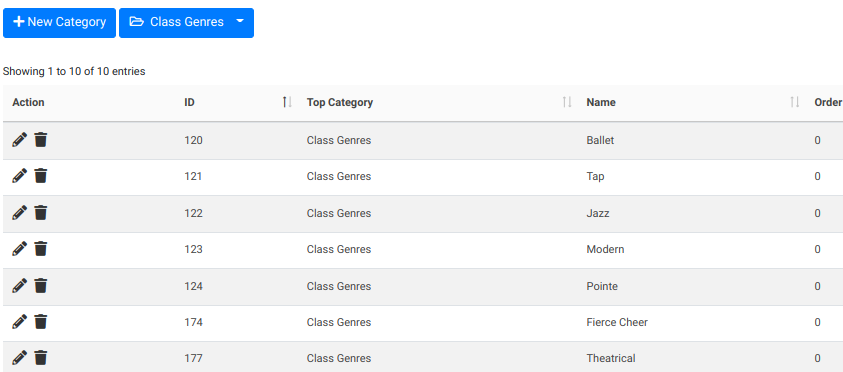
- Go to Settings and open Categories.
- Select the Top Category you want to work on from the dropdown.
- Click the pencil icon to edit an existing category.
- Click the trash can icon to archive a category.
- Click New Category to add a new value.
- Use the Order field to control how the values display.
When you add or edit a category, DSM asks for the Top Category, Name, and Order. Some installations also show icon-related settings for category types that support them.
Note: In most cases, icon settings matter only for Member Categories. If you are using category icons for memberships or member display, review Membership Icons.
Important archiving warning
Be careful when archiving categories that are already used in finance or reporting. Archiving removes them from active dropdowns, but older records may still point to them. In some reports, that can make historical data harder to read later.
If a category is still important for historical reporting, renaming it is often safer than archiving it immediately.
Types of categories in Dance Studio Manager
Below is a practical guide to the major category groups used in DSM. Not every studio will use every category heavily, but understanding them upfront helps you build a cleaner setup.
Charge Categories
Charge Categories are one of the most important category groups in DSM. They are used to organize charges for reports, statements, balances, and financial review.
- January 2026 Tuition
- Registration Fee
- Late Fee
- Recital Fee
- Costume Fee
- Merchandise
- Membership
Studios that run monthly tuition often create one charge category per tuition cycle, such as January 2026 Tuition, February 2026 Tuition, and so on. That makes it easier to review each billing run separately in summary reports.
Billing Schedules
Billing Schedules are used with tuition and class pricing. Typical examples include Monthly, Quarterly, Annually, Term 1, and Drop-In.
A billing schedule is mainly a label or grouping for how tuition or class pricing is organized. It does not run tuition automatically by itself. The admin still needs to run the appropriate charge process, including Global Tuition when needed.
Payment Schedules
Payment Schedules are used to describe payment-plan timing or installment structures. Examples might include Monthly Payments, Quarterly Payments, Yearly Payments, or 3-Payment Plan.
A simple way to explain the difference is this: Billing Schedules describe how tuition or class pricing is grouped, while Payment Schedules describe how payments are planned or collected.
Class Names / Genres
In the software, this field may appear as Genre. In the underlying category structure, it corresponds to what many studios think of as class names or style groupings. Typical values include Ballet, Tap, Jazz, Hip Hop, Modern, Pointe, Lyrical, Acro, and Creative Movement.
Use broad, consistent names here. Avoid making this list too specific unless your staff truly needs that level of detail.
Class Levels
Class Levels help describe the ability level or age grouping for a class. Examples include Beginner, Intermediate, Advanced, Ages 3-5, Ages 6-8, Teen, and Adult.
Some studios use levels for skill progression, while others use them mainly for age ranges. Either approach can work, but it is best to stay consistent.
Class Locations
Class Locations are used when a studio has more than one physical location or location type. Examples might include Main Studio, Downtown, Studio B, Online, or Offsite.
If you only have one location, this category may stay simple. If you have multiple rooms inside the same location, use the separate Rooms feature rather than forcing every room into Class Locations.
Rooms
Current DSM versions include a separate Rooms setup area. Rooms can be connected to locations and may control class-related settings such as capacity and whether the room is used for private lessons or group classes.
Older DSM installations used a Class Rooms category. That older category was later migrated into the standalone Rooms feature. For current users, it is better to think of Rooms as a dedicated feature, not as a normal active category group you should keep building out.
Class Programs
Class Programs are useful for grouping classes into larger tracks or business segments. Examples include Recreational, Adult, Recital, Competition, Company, Summer Series, Camps, and Workshops.
Programs can also help organize how class lists are displayed in the Online Client or app. In some setups, each program can appear under its own tab.
Class Categories
Class Categories are separate from Genres, Levels, and Programs. They are often used for business or registration logic, such as Drop-In, Punch Card, Members Only, Trial Class, Workshop, or Camp.
Use Class Categories when you need to group classes by how they are sold, registered for, or treated operationally, not just by style or level.
How Hear Items
How Hear Items track how a student or family heard about your studio. Examples include Friend, Google, Website, Walk-In, Facebook, Instagram, Yelp, and Other.
This category is useful for marketing analysis and for seeing which sources are actually generating new families.
Payment Methods
Payment Methods are the labels used when recording how a payment was made. Examples include Cash, Check, Credit Card, ACH, PayPal, Gift Certificate, and Other.
Do not confuse Payment Methods with Payment Processors. Payment Methods are reporting and transaction labels. Payment Processors such as Moneris, Bluefin, or Paystri are configured separately.
Purchase Items Categories
Purchase Items Categories organize sales items. Examples include Classes, Punch Cards, Private Lessons, Merchandise, Costumes, Camps, and Gift Cards.
These categories make it easier to manage the items a family can buy through the cart or through admin-side purchases.
Private Lesson Categories
Private Lesson Categories organize one-on-one offerings such as Private Lesson, Coaching, Choreography, Audition Prep, Wedding Dance, or Solo Rehearsal.
Member Categories
Member Categories are one of the most flexible category types in DSM. They can be used to group families, students, members, or contacts into meaningful buckets such as Members, VIP, Trial, Company, Alumni, or Scholarship.
Depending on your setup, Member Categories may affect discounts, communication lists, access, icons, and membership-related behavior.
Pricing Levels
Pricing Levels allow different members or families to be assigned different pricing structures. Examples include Standard, Member, VIP, Staff, and Scholarship.
This is especially useful when your studio offers different rate tables or discount structures to different groups.
Size Systems
Size Systems are used for more detailed costume and apparel size charts. Examples might include vendor-specific systems such as Revolution, Weissman, or your own studio sizing standard.
These are more detailed than simple inventory size labels because they relate to measurements such as waist, hips, bust, girth, or inseam.
Inventory Sizes
Inventory Sizes are the simpler size labels used when tracking inventory items by size, such as XS, S, M, L, Child Small, or Adult Medium.
Inventory Colors
Inventory Colors are used to organize inventory by color, such as Black, White, Red, Blue, Pink, Tan, or Nude.
Time Clock Categories
Time Clock Categories help classify staff time. Examples include Front Desk, Manager, Staff Meeting, Training, Cleaning, Instructor, and Admin.
These categories can also connect to staff time clock pricing or hourly-rate logic, depending on your configuration.
Message Categories
Message Categories organize communication templates and messaging types, such as General, Billing, Recital, Registration, Class Reminder, and Birthday.
This helps keep message templates easier to manage as your communication library grows.
Video Categories
Video Categories organize on-demand videos, class recaps, tutorials, and other video content. Examples include Ballet, Tap, Stretching, Recital Practice, Beginner, or Warmups.
Best practices before you leave this page
- Keep names clear and consistent.
- Do not overload one category to do the job of a different one.
- Think about how a category will look in reports, not just in dropdowns.
- Use Rooms as a feature, not as a substitute for Class Locations.
- Be cautious when archiving categories that are already tied to charges or historical records.
Frequently asked questions about categories
What are categories in Dance Studio Manager?
Categories are reusable dropdown values used throughout DSM. They help organize classes, members, charges, payments, purchases, inventory, messages, videos, and reports.
Should I archive or rename a category?
Rename a category if it is still important for older records or reports. Archive a category only when you no longer want staff selecting it going forward.
What is the difference between Class Genres, Levels, Programs, and Categories?
Genres describe the type of class, such as Ballet or Jazz. Levels describe the ability or age level. Programs group classes into larger tracks such as Recreational or Company. Class Categories are often used for registration types, class business rules, or sales-item behavior.
What is the difference between Billing Schedules and Payment Schedules?
Billing Schedules describe how tuition or pricing is grouped. Payment Schedules describe how payments are planned or collected.
Are Rooms the same as Class Locations?
No. Class Locations usually represent a studio branch, venue, or online/offsite location. Rooms are more specific spaces inside a location and are managed through the separate Rooms feature.
Need help configuring your categories?
If you are setting up DSM for the first time or cleaning up an older studio database, categories are one of the best places to pause and plan carefully. A well-organized category structure will save you time later in billing, reporting, class setup, and communication.
If you need help, contact Dance Studio Manager or post in the support forum so we can help you think through the cleanest setup for your studio.