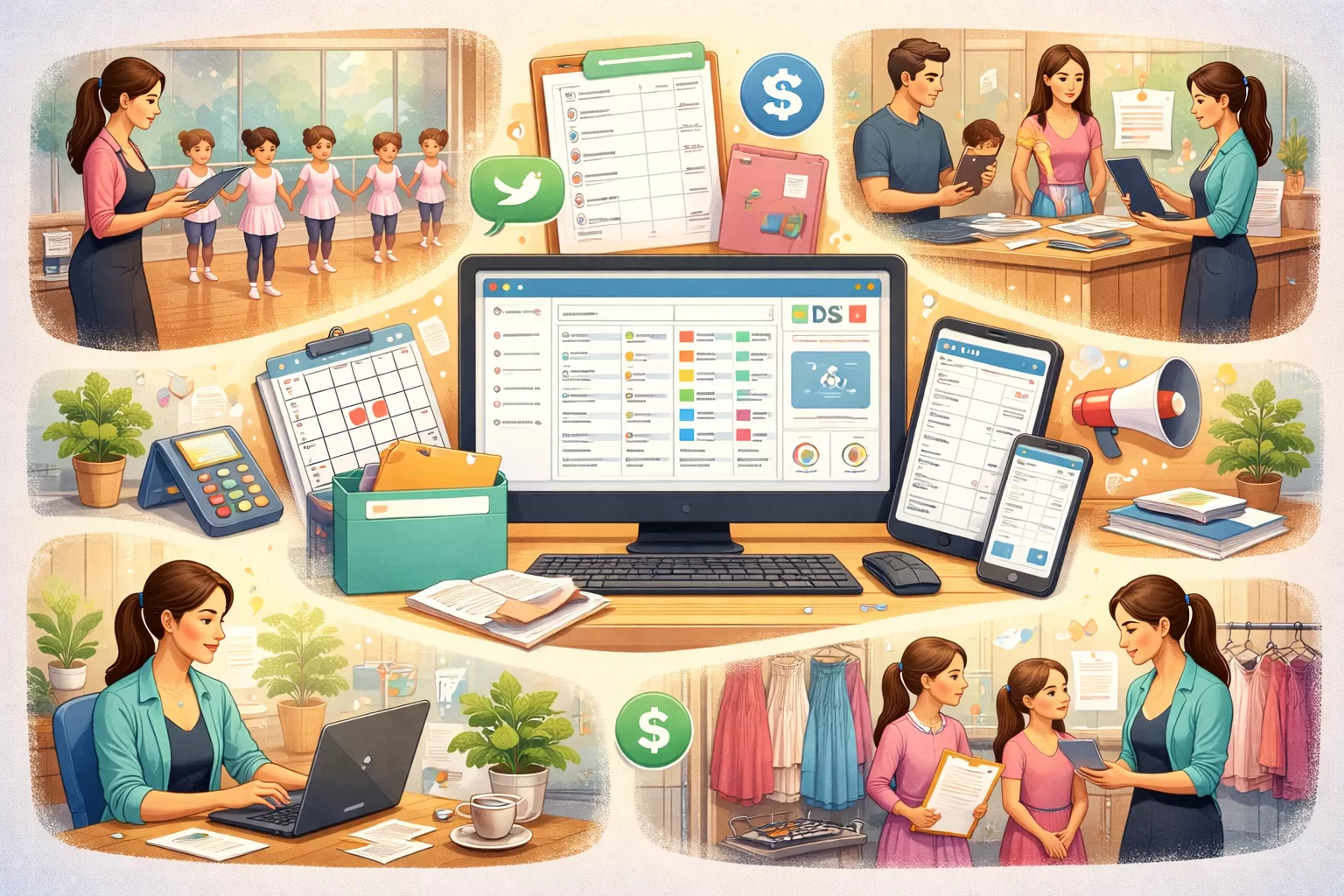
How Dance Studio Manager (DSM) Helps Dance Studios Stay Organized
As dance studios grow, organization becomes harder to maintain manually.
What once worked with spreadsheets, notebooks, and group chats can quickly turn into:
Many studio owners eventually realize that growth creates operational complexity—not just more students.
That’s why more studios are turning to Dance Studio Manager (DSM) to simplify daily operations and create a more organized experience for staff, parents, and students.
Why Organization Matters More in 2026
Modern dance studios are managing more moving parts than ever before.
Studio owners now juggle:
At the same time, parent expectations continue to rise.
Families increasingly expect:
Without a centralized system, operations can become difficult to manage efficiently.
The Problem With Manual Systems
Many studios still rely heavily on:
While these systems may work temporarily, they often become harder to maintain as the studio grows.
Common issues include:
Over time, manual systems create more administrative work instead of reducing it.
What DSM Helps Centralize
One reason studios use Dance Studio Manager (DSM) is because it centralizes multiple operational tasks into one platform.
📅 Scheduling Management
Scheduling is one of the most time-consuming parts of running a dance studio.
DSM helps studios organize:
Instead of updating multiple spreadsheets manually, schedules can be managed from one system.
💸 Billing & Payment Tracking
Manual billing often creates stress for both studios and parents.
DSM helps streamline:
This helps reduce missed payments and billing confusion.
👨👩👧 Parent Communication
Communication is one of the biggest retention factors in dance studios today.
Parents expect:
DSM helps centralize communication so important updates are easier to manage and distribute.
✅ Attendance Tracking
Tracking attendance manually can become difficult as enrollment increases.
DSM helps studios manage:
This improves organization and reduces paperwork.
📊 Reporting & Insights
Many studio owners struggle to see clear operational data.
DSM helps provide visibility into:
Better insights help studios make more informed decisions.
Why Parent Experience Is Becoming a Priority
In 2026, parents increasingly evaluate studios based on organization and convenience—not just instruction quality.
Studios that appear:
This is one reason many studios are investing in systems that improve overall parent experience.
How DSM Helps Reduce Burnout
Administrative overload is becoming one of the biggest challenges for dance studio owners.
Many spend hours every week handling repetitive tasks like:
Centralized systems help reduce repetitive manual work, allowing owners to focus more on teaching and studio growth.
Spreadsheet Systems vs DSM Systems
Area
Manual Systems
DSM
Scheduling
Manual updates
Centralized scheduling
Billing
Spreadsheet tracking
Automated payment tools
Communication
Multiple apps
Unified communication
Attendance
Paper/manual logs
Digital tracking
Reporting
Manual calculations
Real-time insights