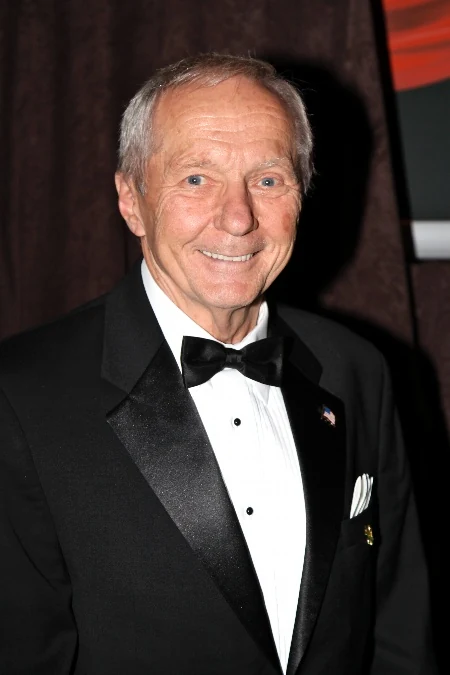
Dennis Rogers spent a lifetime doing far more than participating in ballroom dancing. He helped hold the American ballroom community together.
The National Dance Council of America announced that Dennis passed away on August 22, 2026. He had been a professional dancer, teacher, coach, choreographer, studio owner, adjudicator, Chairman of Judges, and one of the NDCA's longest-serving organizational leaders.
Those titles describe an extraordinary career, but they do not completely explain his influence. Dennis understood dance from nearly every side: as a student discovering it, a teacher standing in front of a first class, a business owner responding to a changing public, a competitor, and an official responsible for helping an entire industry function.
His dancing life began with tap
Dennis began dancing at four years old alongside his identical twin brother, Don. The brothers spent roughly 12 years tap dancing together and appeared on the Ted Steele Show during the early years of television.
Dance was already part of his life, but ballroom teaching arrived almost by accident. As Dennis later told the story, he was 17 and taking his younger brother to lessons in Paterson, New Jersey, when a teacher asked whether he knew anyone who could teach a ballroom class. Six couples were prepared to pay $6 apiece, with half going to the teacher.
Dennis was then earning 75 cents an hour at a part-time job. He quickly worked out that the class would pay him $18—the equivalent of 24 hours at that job—and volunteered to teach it.
There was one important complication: he did not yet know enough ballroom dancing to teach the class. He began learning steps from a college classmate on Friday nights and teaching what he had learned on Mondays. What could have been a brief experiment became the beginning of a remarkable professional life.
A studio owner who knew how to adapt
By 1959 Dennis was teaching at Arthur Murray in Paterson. He later taught in New York, worked independently, competed professionally with Fran Rogers, and eventually opened his own school in Westfield, New Jersey.
His studio experience is especially meaningful to today's dance studio owners. Dennis did not spend his career following a single unchanging formula. When the Hustle became a national phenomenon, he and Jackie Rogers recognized what people wanted and built a welcoming place for them to learn it.
Dennis estimated that approximately 20,000 people passed through their studio in a little more than four years during that period. That number represents more than a successful dance trend. It reflects what a studio can become when strong teaching, community interest, and good timing meet.
The styles people request will change. The way they discover studios will change. Even the systems used to register students, collect tuition, and organize classes will change. The lasting part is the studio's ability to help people enter the dance world and feel that they belong there.
Helping build the institutions behind the dancing
Dancers usually see the finished competition: the music, polished floor, judges, schedule, and awards. They do not always see the years of committee work, rule discussions, budgeting, credentialing, and problem-solving required to make that event possible.
Dennis spent decades doing that less visible work. He began representing the USISTD in national organizational meetings in 1963. He served as NDCA President from 1971 to 1972, Second Vice-President from 1989 to 1992, and Treasurer from 1992 until his passing. He also contributed to executive, finance, ballroom, and scrutineering responsibilities over the years.
For many competitors and organizers, Dennis was most familiar as a Chairman of Judges. The role extended well beyond assigning panels. A chairman might help repair a difficult schedule, keep events moving, interpret rules, respond to unexpected problems, and support the organizer throughout a long competition.
Dennis and Jackie traveled to competitions year after year, often working many weekends in succession. Even in 2026, Dennis remained active at major ballroom events. His longevity was not simply a matter of holding titles; it was a record of continuing to show up.
A career recognized across American ballroom dancing
The dance community formally recognized Dennis's contributions many times. He was inducted into the United States Dance Sport Hall of Fame in 2000, received the DBDC Lifetime Achievement Award in 2017, and became an Honorary Life Member of the NDCA in 2019.
One of Dennis's own observations may explain his commitment better than a list of awards. Speaking about the disagreements and politics that sometimes accompany dance organizations, he said:
“This is my industry. I can't walk away from it; I cannot abandon it.”
That sense of stewardship is an important legacy. An industry is not maintained only by its most visible champions. It also depends on teachers opening studios, organizers creating events, officials accepting responsibility, mentors sharing what they know, and people who stay involved long enough to give the next generation a foundation.
Watch Dennis tell the story in his own words
In this conversation with John DePalma for Ballroom BackStage, Dennis discusses the history of American ballroom dancing and his own path through the industry. The interview adds something a written remembrance cannot: the chance to hear his memories, humor, and perspective in his own voice.
Watch the Dennis Rogers interview directly on YouTube.
How fellow professionals described his influence
A DBDC Lifetime Achievement tribute offers a different perspective on Dennis's career. Colleagues remember not only a respected official, but someone whose knowledge stretched from teaching and running a studio to chairing judges and guiding competitions.
Again and again, they return to the same qualities: reliability, fairness, humility, calm authority, and a willingness to help. One colleague recalls that when Dennis encountered a rule problem, he preferred to explain it and give a warning so the issue could be solved without embarrassing anyone. Others credit him with helping the profession remain organized and credible while generously supporting dancers, organizers, and fellow officials.
Dennis also reflects on the choices that led him into dance and expresses satisfaction with the life he built. That makes the presentation especially meaningful now: it records not only the industry's gratitude, but Dennis's own appreciation for a career spent doing work he enjoyed.
Watch the Dennis Rogers Lifetime Achievement tribute directly on YouTube.
What studio owners can carry forward
Dennis's path offers several quiet lessons for anyone responsible for a dance studio.
- Begin before everything feels perfect. His first ballroom class started with more confidence than experience, followed by a serious commitment to learning.
- Pay attention when the public's relationship with dance changes. His studio's Hustle years showed the importance of meeting enthusiasm with organized, accessible teaching.
- Support the structures surrounding your own business. Competitions, professional organizations, teacher training, and shared standards survive because experienced people contribute time beyond their immediate studios.
- Keep the human purpose in view. Behind every registration and class count is a person entering dance, sometimes for the first time.
Dennis Rogers lived through a large portion of modern American ballroom history, but he also helped make that history. His influence remains in the organizations he served, the events he helped guide, the teachers and dancers he encouraged, and the family members who continued in dance.
Our condolences go to Jackie, his family, his friends, and the many people throughout the ballroom community who knew and worked with him.
Read the fuller Dennis Rogers tribute and follow memorial updates on Dance Forums.
Sources
- Dance Forums: Dennis Rogers Tribute
- National Dance Council of America: United States Dance Sport Hall of Fame
- National Dance Council of America: Honorary Life Members
- WikiDanceSport: Dennis Rogers
- Ballroom BackStage: John DePalma and Dennis Rogers — History of Ballroom Dancing Face to Face
- DBDC: Dennis Rogers Lifetime Achievement Award
Published August 23, 2026. Memorial information can change as the family and dance organizations release further details. The linked Dance Forums tribute will be updated when additional information becomes available.