Dance Studio Manager Finance Guide
Scheduled payments in Dance Studio Manager.
Scheduled Payments help your studio plan, track, and process future payments. They are especially useful for tuition payment plans, recurring memberships, installment billing, subscription-style programs, and families who need to spread a balance over multiple payments.
A scheduled payment is not the same thing as a completed payment. It is a future planned payment that DSM expects to process or record on a specific date. Once it has been successfully processed or linked to a real payment, it belongs with payment history rather than future payment planning.
Scheduled Payments
Shows what is expected to happen in the future.
Payment History
Shows what has already happened and been recorded.
Best uses
Payment plans, recurring memberships, installment billing, and future revenue forecasting.
Why scheduled payments are useful
- Predict future income
- Track upcoming payment-plan installments
- See which families already have payments arranged
- Avoid contacting families who are already on a plan
- Review failed or processing-error payments
- Pause or terminate future payments when needed
- Connect payments to purchases, charges, or account balances
This is especially helpful for studios using monthly tuition, memberships, subscriptions, recital installment plans, competition fees, or costume payment schedules.
Scheduled Payments vs. Payment History
The Scheduled Payments tab shows future or planned payments.
The Payment History tab shows payments that have already been processed, recorded, or completed.
A simple way to explain it to staff is:
- Scheduled Payments = what is expected to happen
- Payment History = what already happened
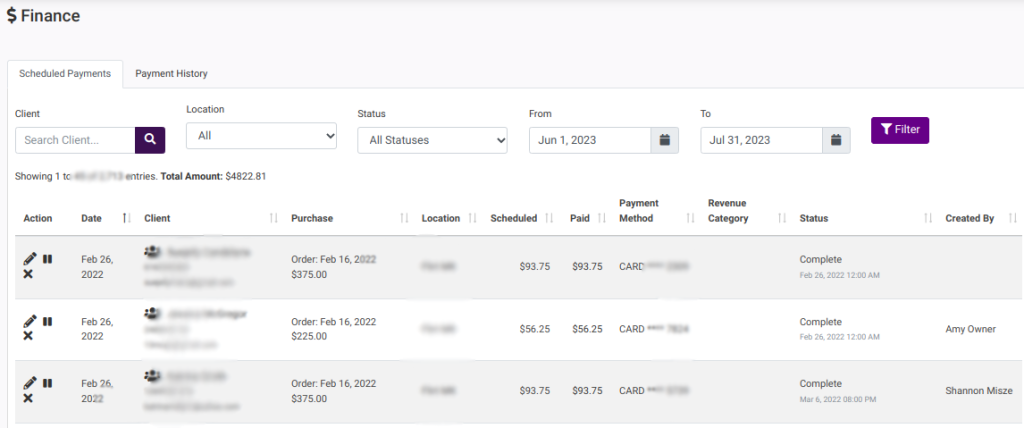
Understanding scheduled payment statuses
Scheduled
The payment is planned for a future date and has not yet been processed.
Complete
The scheduled payment has been completed or connected to an actual payment.
Processing Error
DSM attempted to process the payment, but something went wrong, such as a card decline or invalid token.
On Hold
The payment is paused and should not be attempted while on hold.
Terminated
The payment has been stopped and should not be processed in the future.
Processing
The payment is currently being processed or is in a processing state.
Filtering scheduled payments
The Scheduled Payments screen includes several filters.
- Client to search for a specific client or family
- Location for multi-location studios
- Status to focus on Scheduled, Complete, Processing Error, On Hold, Terminated, or Processing
- From / To Dates to review a specific time period
For example, you might filter from the first day of the month to the last day of the month to estimate expected payment volume for that period.
DSM also calculates a total amount for the filtered list, which makes this screen useful for revenue forecasting.
Some installations also support display settings such as Show Member ID, Show Revenue Category, and Show Location.
What each scheduled payment can include
When editing a scheduled payment, DSM may show several fields depending on how the payment was created.
- Apply To if the payment is not already tied to a purchase, order, or sales item, so it can be applied to account balance or a selected unpaid charge
- Amount for the planned payment amount
- Card / ACH when payment processing is enabled and a saved method is available
- Payment Date for the scheduled processing date
- Related Payment if the scheduled payment should be linked to an existing payment record
How scheduled payments are created
Payment plans
A staff member can create a payment plan for a balance or charge. DSM then creates one or more scheduled payments with dates, amounts, and an assigned payment method.
Recurring purchases or subscriptions
When a purchase or membership uses recurring billing, DSM can create scheduled payments for future installments.
Additional scheduled payments on sales items
Sales items can also create additional scheduled payments. This is useful when a purchase needs multiple installments after the initial transaction.
Manual scheduled payments
Staff can also manually add or edit scheduled payments from a client account or from the Finance area.
Editing, pausing, or deleting scheduled payments
From the Scheduled Payments list, staff can use the action icons to manage a payment.
- Edit the scheduled payment
- Pause or put the payment on hold
- Delete or terminate the scheduled payment
If a payment is on hold, DSM should not attempt to charge it until it is reactivated. This is useful when a family requests a temporary pause, needs to update a card, or has made a special arrangement with the studio.
Saved cards and ACH accounts
Scheduled payments work best when the family has a saved card or ACH account on file. The scheduled payment form allows staff to choose the saved payment method when processing is enabled.
If the family changes cards or updates billing information, future scheduled payments can usually be updated to use the correct token, helping the next payment continue smoothly.
Scheduled payments in the Online Client
DSM can also show future scheduled payments in the Online Client. Clients may be able to see the payment date, purchase, location if enabled, amount, payment method, and status.
This helps families understand what is planned to be charged in the future.
Using scheduled payments with outstanding balances
Scheduled Payments are closely related to the Outstanding Balances report.
- Run the Outstanding Balances report.
- Review the Total Scheduled column.
- Contact only the families who owe money and do not already have payments scheduled.
- For families who need help, create a payment plan.
- Review Scheduled Payments weekly to confirm payments are processing successfully.
Related guide: Track Outstanding Balances
Exporting scheduled payments
The Scheduled Payments screen can be exported to PDF or Excel.
- Use Excel when you want to sort, filter, or create a planning sheet.
- Use PDF when you want a clean report to print, save, or share with staff.
You may also be interested in other Revenue Reports available in DSM.
Frequently asked questions about scheduled payments
What is a scheduled payment?
A scheduled payment is a future planned payment. It may be connected to a purchase, payment plan, charge, order, or account balance.
Is a scheduled payment the same as a payment?
No. A scheduled payment is planned for the future. A payment in Payment History has already been processed or recorded.
Can I pause a scheduled payment?
Yes. A scheduled payment can be put on hold so DSM does not attempt to process it until it is reactivated.
Can scheduled payments be tied to a saved card or ACH account?
Yes. If payment processing is enabled and the client has a saved card or ACH account, the scheduled payment can be assigned to that method.
Can I see scheduled payments for one client?
Yes. Use the Client search filter on the Scheduled Payments screen.
Can I estimate future income from scheduled payments?
Yes. Filter by date range, such as the current month, and DSM will show the scheduled payments and total amount for that filtered list.
Can clients see their scheduled payments?
Yes. DSM can show future scheduled payments in the Online Client, including dates, amounts, payment methods, and statuses.
What should I check if a scheduled payment fails?
Check the status, the saved payment method, the card or ACH details, the processor response, and whether the family’s account still has a valid token on file.